
Yes. Not every fracture produces an obvious change in the shape of a limb. Pain, swelling, tenderness or difficulty using the affected area may occur, but these symptoms can also have other causes. A healthcare professional may recommend an examination and imaging such as an X-ray when a fracture is suspected.
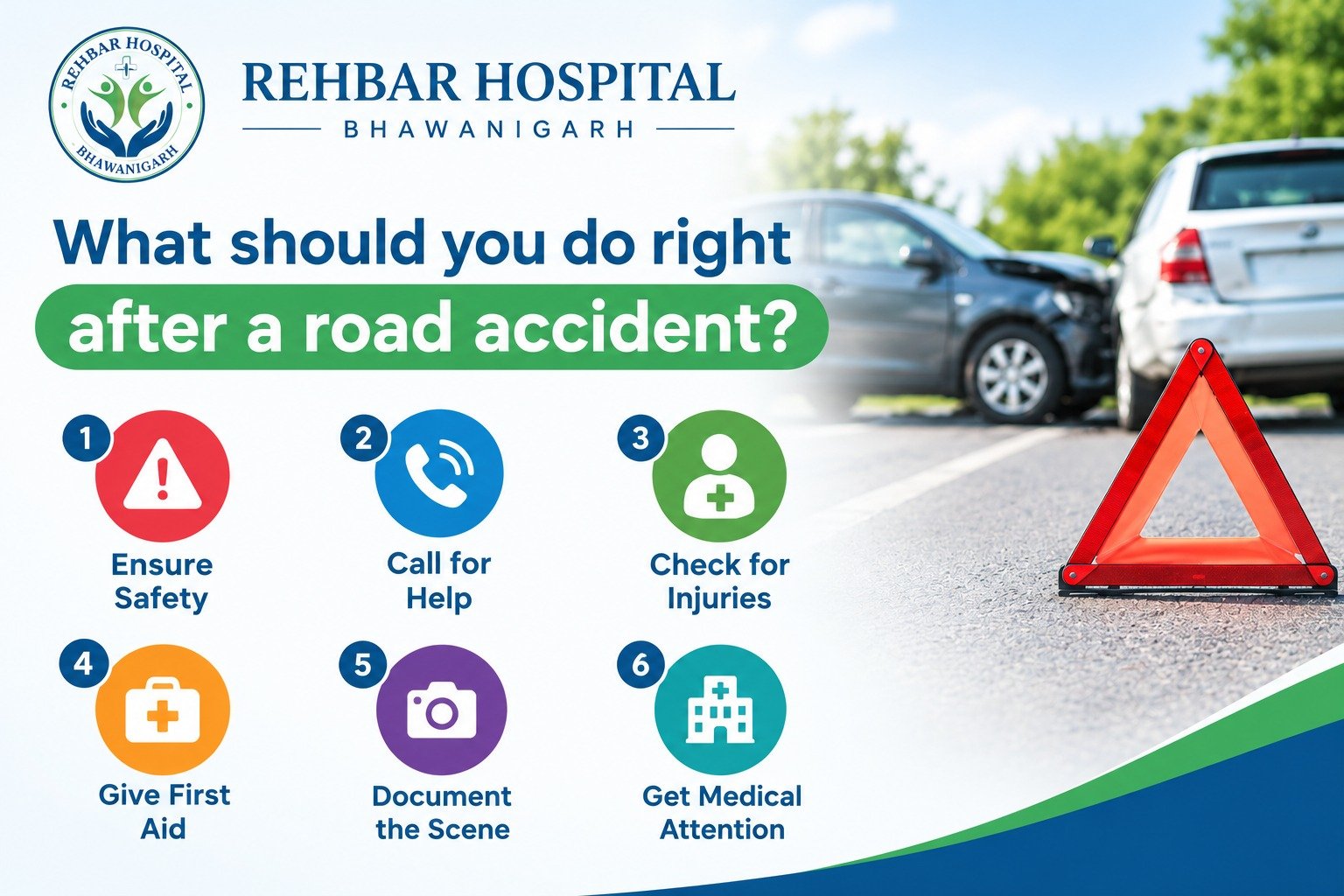
What should you do right after a road accident?
The first steps after a road accident are simple:
Make the area safe.
Call emergency help if someone may be badly hurt.
Do not move an injured person unless there is danger.
Check for heavy bleeding and other serious problems.
Give basic first aid only if you know how to do it safely.
Get medical help quickly if there are warning signs or a serious crash.
WHO says you should first make the crash area safe. Then call for help, give basic first aid, and take injured people to a health care center. Also, be careful when moving a person. A neck or back injury may be present.
Step 1: Make the accident scene safe
Before you help, check for danger. Cars, fire, fuel leaks, broken wires, damaged vehicles, and other dangers can hurt you or the injured person. So, if it is safe, warn other drivers and move to a safe place. WHO says the crash area should be made safe to stop more crashes and injuries. Do not put yourself in danger to reach a person trapped in a car.
If there is fire, smoke, a risk of an explosion, or another serious danger, call emergency help. Then follow the operator’s instructions.
Step 2: Call for emergency help
Call for emergency help at once if someone:
Is not awake ?
Has heavy bleeding ?
Has trouble breathing ?
May have a serious head or back injury ?
Has major injuries ?
May be in danger of dying ?
In India, 112 is the single emergency number for police, fire, and health help.
When you call, tell the operator ?
Where you are or the nearest clear landmark ?
How many people are hurt ?
If anyone is not awake ?
If anyone has heavy bleeding or trouble breathing ?
If anyone is trapped in a car ?
Any clear danger at the crash site ?
Stay on the call. Also, follow the operator’s advice.
Step 3: Avoid extra movement
After a serious road crash, a neck or back injury may be present. So, avoid moving the person unless there is an immediate danger.
Do not pull a hurt person from a car just because they feel uncomfortable. Move them only if staying there could cause serious harm, such as fire.
WHO says to keep movement of the neck and back as low as possible when taking someone out of a car.
If a person is awake and has a clear arm or leg injury, keep that part still as much as you can.
Do not try to straighten a bent or deformed arm or leg yourself.
Step 4: Look for serious bleeding
Heavy bleeding needs quick help. If it is safe and you know basic first aid, press firmly on the wound with a clean cloth or suitable dressing. Keep getting emergency help. Do not stop emergency care just because the bleeding has slowed for a while. WHO says early care for heavy bleeding is an important part of basic care after a serious injury.
Step 5: Check for signs of a serious head injury
A person may look fine after a crash and still have a serious injury.
After a blow to the head, warning signs can include:
Passing out
Becoming very sleepy or hard to wake
Seizures
New weakness or numbness
Trouble walking or keeping balance
Trouble speaking or understanding
Problems with sight or hearing
Vomiting more than once
Clear fluid or blood from the nose or ears
A very bad or worsening headache
A large wound or clear change in the shape of the head
The NHS says some of these signs need urgent medical care. It also lists a high-speed road crash as a reason to get urgent help after a head injury. So, if someone had a strong blow to the head, do not assume they are safe just because there is no clear wound.
What injuries can happen after a road accident?
Road accidents can cause many types of injury.
Possible injury | What you may notice |
Broken bone | Pain, swelling, a sore area, trouble using an arm or leg, or a change in shape |
Sprain or soft-tissue injury | Pain, swelling, and less movement |
Head injury | Headache, confusion, sleepiness, vomiting, or other brain-related signs |
Spinal injury | Neck or back pain, weakness, numbness, or trouble moving |
Chest injury | Chest pain, trouble breathing, or pain when touched |
Belly injury | Belly pain, soreness, weakness, or other worrying signs |
Cuts and wounds | Bleeding, pain, or damaged skin and tissue |
These signs do not prove what the injury is. Some serious injuries may have few clear signs at first. So, medical care may be important after a serious crash.
When should you go to a hospital after a road accident?
Medical care is very important if there is:
Loss of consciousness
Trouble breathing
Heavy bleeding
A strong blow to the head
A possible broken bone
Severe or worsening pain
Weakness, numbness, or other nerve-related signs
Chest or belly symptoms
Any doubt about how serious the injury may be
Even if a person looks fine after a major crash, they should not assume that all is well. Some signs may appear later. The right type of care depends on the injury, the person’s symptoms, and the type of crash.
What happens during road accident treatment?
Treatment usually starts with a check of the person’s condition.
Depending on the injury, health workers may check:
Breathing
Blood flow
Bleeding
Brain and nerve signs
Pain
Movement
Other signs of injury
Next, they may do more checks or tests. For example, an X-ray may be needed if a broken bone is suspected.
Treatment can be different for each person. It may include:
Cleaning a wound
Keeping an injured body part still
Using a cast or splint
Pain relief
Surgery
Watching the patient
Sending the patient to another doctor
Physical therapy
At Rehbar Hospital in Bhawanigarh, the Emergency & Trauma department says it cares for road traffic accidents, broken bones, wounds, and other urgent problems. Its Orthopedics department also lists care for broken bones and joint injuries, X-rays, surgery when needed, and physical therapy.
Why should possible broken bones be checked by a doctor?
A broken bone is not always easy to see. Pain and swelling can happen with many injuries. Also, some broken bones may cause only mild signs. A medical check can show if a bone is broken.
It can also show if the person needs:
A splint
More tests
Care from a bone specialistSurgery
Rehbar Hospital says its bone care service checks and treats broken bones and joint injuries. It also says that it has X-ray and bone care support.
What should you avoid doing after a road accident?
Avoid:
Moving an injured person when there is no need
Trying to straighten a possible broken bone
Pulling an object out of a wound
Giving food or drink to a person who may need urgent treatment or surgery
Driving a badly injured or unconscious person yourself when an ambulance or emergency transport is needed
Ignoring signs just because there is no visible wound
Waiting too long for medical care while trying to work out the injury yourself
The safest step depends on what happened
If a person is trapped, not awake, bleeding heavily, or very badly hurt, call emergency services at once.
Road accident treatment in Bhawanigarh
For people in Bhawanigarh, Sangrur, and nearby areas, it can help to know where emergency care is available before an accident happens. Rehbar Hospital is at Fagguwala Kenchiyan, Sangrur Road, Bhawanigarh, Punjab. Its website says that its Emergency & Trauma unit is open 24 hours a day, 7 days a week. It says the unit treats road traffic accidents, broken bones, wounds, and other urgent problems.
The hospital also lists:
Orthopedics
General Surgery
Pathology & Diagnostics
Physiotherapy
as health services.
For a current emergency, call emergency services or the hospital directly.
Do not use an online article to decide what care a person needs.
A simple checklist to remember
After a road accident, remember:
Safety → Emergency help → Less movement → Stop heavy bleeding → Medical check
The main goal is not to find the exact injury at the crash site.
Instead, look for signs that a person may be badly hurt.
Then get the right help as soon as you can.
This article is for general health information. It does not replace advice, diagnosis, or treatment from a health professional.
If you have worrying or worsening symptoms after a road accident, contact a qualified health professional or get emergency help.
Key Takeaways
Make the crash area safe before you help.
Call 112 in India when emergency help is needed.
Do not move a person more than needed if they may have a neck, back, or spinal injury.
Heavy bleeding, being unconscious, trouble breathing, nerve-related signs, and a serious head injury need urgent medical care.
A broken bone or internal injury may not be easy to see.
After a serious road crash, a quick medical check can help find injuries and choose the right treatment.
FAQs
What should I do first after a road accident?
First, make sure the scene is reasonably safe and avoid putting yourself in danger. Then call emergency services if anyone may be seriously injured. Avoid unnecessary movement of injured people, particularly after a high-impact crash, and provide basic first aid only when it is safe and you know how to do it.
What is the emergency number for a road accident in India?
India’s pan-India emergency response number is 112. It can be used to request emergency assistance involving health, police and fire services. In a serious road accident, provide the operator with the location, number of injured people and important details such as unconsciousness, severe bleeding or people trapped in vehicles.
Should I move someone injured in a car accident?
Avoid unnecessary movement because a significant accident can involve neck or spinal injuries. If the person is in immediate danger from fire, traffic or another hazard, emergency responders should be contacted and the person may need to be moved to safety. WHO guidance recommends minimising spinal movement during extrication.
How do I know if a road accident caused a serious head injury?
Warning signs can include loss of consciousness, increasing drowsiness, seizures, weakness or numbness, difficulty walking or speaking, repeated vomiting, vision problems, clear fluid or blood from the ears or nose, and other neurological changes. A high-speed road accident involving a head impact warrants medical attention even if the injury initially appears minor.
